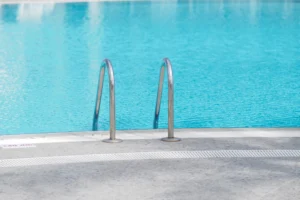
Rubaroc vs. Polyaspartic Concrete Coatings: Which Is Right for Your Pool Deck?
Blog Rubaroc Vs. Polyaspartic: Which is right for your Pool Deck? Thinking about Rubaroc rubber surfacing for your pool deck or patio? See how it

If you’ve started researching concrete floor coatings, you’ve probably run into a wall of confusing terminology. Epoxy. Polyurea. Polyaspartic. Hybrid. Every contractor seems to use different language, and half of them use these terms interchangeably — which they absolutely are not. The coating on your garage, basement, or patio floor is a long-term investment. Getting it wrong means peeling, yellowing, and a full redo in three to five years. Getting it right means a floor that outlasts your mortgage. Here’s the honest breakdown of every major coating type, what each one actually does, and why it matters for Fort Wayne homeowners specifically.
The Honest Comparison
Every category. All four systems. No spin.
| Category | Epoxy | Polyurea | Polyaspartic | The Armor Core System™ |
|---|---|---|---|---|
| Flexibility | Poor | Excellent | Good | ✦ Excellent |
| Moisture Resistance | Poor | Excellent | Good | ✦ Excellent |
| UV Stability | Poor | Excellent | Excellent | ✦ Excellent |
| Cure Time | 24–72 hrs | 2–4 hrs | 2–6 hrs | 1-Day Install |
| Temp Range | 55°F–140°F | -40°F–200°F | -20°F–200°F | -40°F–200°F |
| Abrasion Resistance | Fair | Good | Excellent | ✦ Excellent |
| Fort Wayne Climate | ✗ Not Recommended | ✓ Excellent | ✓ Excellent | ✦ Built for It |
| Warranty | 1–3 years typical | Varies by contractor | Varies by contractor | Lifetime |
Performance ratings reflect real-world conditions in Northeast Indiana's climate. Individual product results vary by formulation and installer.
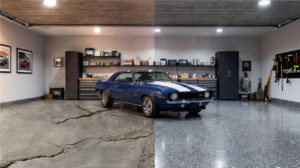
Epoxy has been the default garage floor coating for decades, and it earned that reputation for a reason — when it was introduced, nothing else was widely available at a comparable price point. The problem is that epoxy hasn’t kept pace with what we now know about concrete chemistry and climate performance.
Epoxy is a two-part thermosetting resin — meaning once it cures, it becomes rigid and inflexible. That rigidity is its fatal flaw in a place like Fort Wayne, Indiana, where concrete slabs expand and contract through 28-plus freeze-thaw cycles every year. As your slab moves, epoxy can’t move with it. The result is microscopic cracking, delamination, and eventually the peeling and flaking that most homeowners associate with a “bad coating job.” In most cases, it wasn’t a bad job — it was the wrong product for the climate.
The other major problem with epoxy is moisture. Fort Wayne sits on clay-heavy soil that retains groundwater year-round. That moisture migrates upward through concrete slabs through a process called hydrostatic pressure. Epoxy, once cured, is essentially a rigid plastic lid. The moisture builds pressure beneath it until the bond fails — usually within three to five years in Indiana’s climate. You’ve seen it: bubbling, popping, lifting sections. That’s not a contractor error. That’s physics.
Additional epoxy drawbacks worth knowing:
Who epoxy is right for: Temperature-controlled interior spaces with no moisture concerns, no UV exposure, and light traffic. Think a server room or a dry utility closet. Not a Fort Wayne garage.
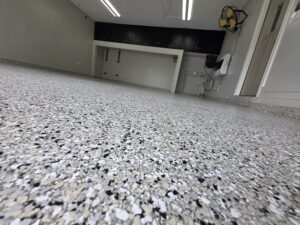
Explore our professionally curated flake combinations and discover the look that fits your home.
Polyurea represents a fundamental leap forward in concrete coating chemistry — and understanding why requires getting into what makes it genuinely different from epoxy at a molecular level.
Where epoxy is rigid, polyurea is elastomeric — meaning it retains a degree of flexibility after curing. That flexibility allows it to expand and contract with your concrete slab through freeze-thaw cycles without cracking or delaminating. For Indiana homeowners, this isn’t a minor upgrade. It’s the difference between a coating that survives one winter and one that lasts a lifetime.
Flexibility — Polyurea can flex up to 98% elongation before failure. Epoxy typically fails at less than 2% elongation. When your Fort Wayne slab moves in January, polyurea moves with it.
Moisture resistance — Properly formulated polyurea, when paired with a dedicated moisture mitigation layer, can be applied over substrates with measurable moisture vapor emissions that would immediately cause an epoxy coating to fail. This is critical in Indiana’s clay-soil environment where hydrostatic pressure is a year-round reality, not just a seasonal concern.
UV stability — 100% polyurea topcoats are inherently UV-stable. They won’t yellow, chalk, or fade with sun exposure — making them suitable for patios, pool decks, and driveways, not just interior garages.
Rapid cure — Polyurea systems cure in two to four hours to foot traffic and 24 hours to vehicle traffic, meaning a full installation is completed in a single day with minimal disruption to your household.
Adhesion strength — When applied over a properly diamond-ground surface, polyurea achieves a mechanical bond — physically interlocking with the opened pores of the concrete rather than simply adhering to the surface. Surface preparation isn’t a preliminary step. It’s the foundation everything else depends on.
Temperature range — Polyurea can be applied and performs reliably from -40°F to 200°F. Epoxy fails to cure properly below 55°F and loses structural performance above 140°F — eliminating most of the Fort Wayne calendar as a viable installation window.
One thing worth being honest about: not all polyurea products are equal. There is a wide spectrum from 100% pure polyurea formulations to polyurea blends that have been cut with cheaper materials to reduce cost. When evaluating contractors, ask specifically whether their product is 100% polyurea or a blend — and ask to see the product data sheet. Any reputable contractor using quality materials should be able to produce it without hesitation. If they can’t or won’t, that tells you everything you need to know.
Polyaspartic is a subset of polyurea — a second-generation aliphatic polyurea that was developed primarily to address two limitations of traditional polyurea: pot life and aesthetic finish quality.
“Pot life” refers to the window of time a mixed coating remains workable before it begins to cure. Aliphatic polyurea formulations (which include polyaspartic) react more slowly than standard aromatic polyurea, giving applicators more time to work. This makes polyaspartic easier to apply in large commercial spaces where a crew needs to cover thousands of square feet before the product begins to set.
What polyaspartic does exceptionally well:
Where polyaspartic has limitations:
Polyaspartic is almost always used as a topcoat — a finishing layer applied over a base coat, not as a standalone coating system. Its extreme hardness, while an advantage in service, can make surface preparation and adhesion more demanding. Application temperature and humidity must be carefully managed. And because polyaspartic cures faster than many other systems, it requires experienced applicators — a rushed or uneven application will show.
For residential garages, the distinction between polyurea and polyaspartic is often academic when both are part of a well-engineered system. The Armor Core System™ incorporates polyaspartic chemistry in the OverShield layer — combining the flexibility of the polyurea base with the chemical and abrasion resistance of the polyaspartic topcoat.
In the concrete coating industry, “hybrid” refers to systems that combine two or more coating chemistries to engineer performance that no single product could achieve alone. This is the direction the best contractors in the industry have moved, and it’s the foundational principle behind The Armor Core System™.
Here’s why hybrid systems outperform single-chemistry approaches:
A 100% polyurea base coat gives you flexibility, moisture resistance, and rapid cure — but it’s a softer material that benefits from a harder topcoat for long-term wear resistance. A polyaspartic topcoat gives you chemical resistance, abrasion hardness, and UV stability — but applying polyaspartic directly to concrete without a flexible base layer underneath still leaves you vulnerable to slab movement and moisture. A broadcast color flake layer between the two creates the decorative finish and adds additional mechanical bonding surface area.
Used together in a proper sequence, these chemistries are complementary. Each layer solves a problem the other layers can’t.
The Armor Core System™ is a five-layer hybrid system, engineered specifically for Indiana’s climate and soil conditions:
Preparation, structure, and process determine how a floor performs over time.
The Armor Core System™ is designed to control each of these variables, creating a surface built for long-term durability, adhesion, and consistency.
A structured system where every layer serves a defined purpose from preparation through final finish.
Walk on it tomorrow. Our rapid-cure system means zero downtime.
Hundreds of happy homeowners across Allen County and beyond.
We stand behind every job with our industry-leading lifetime warranty.
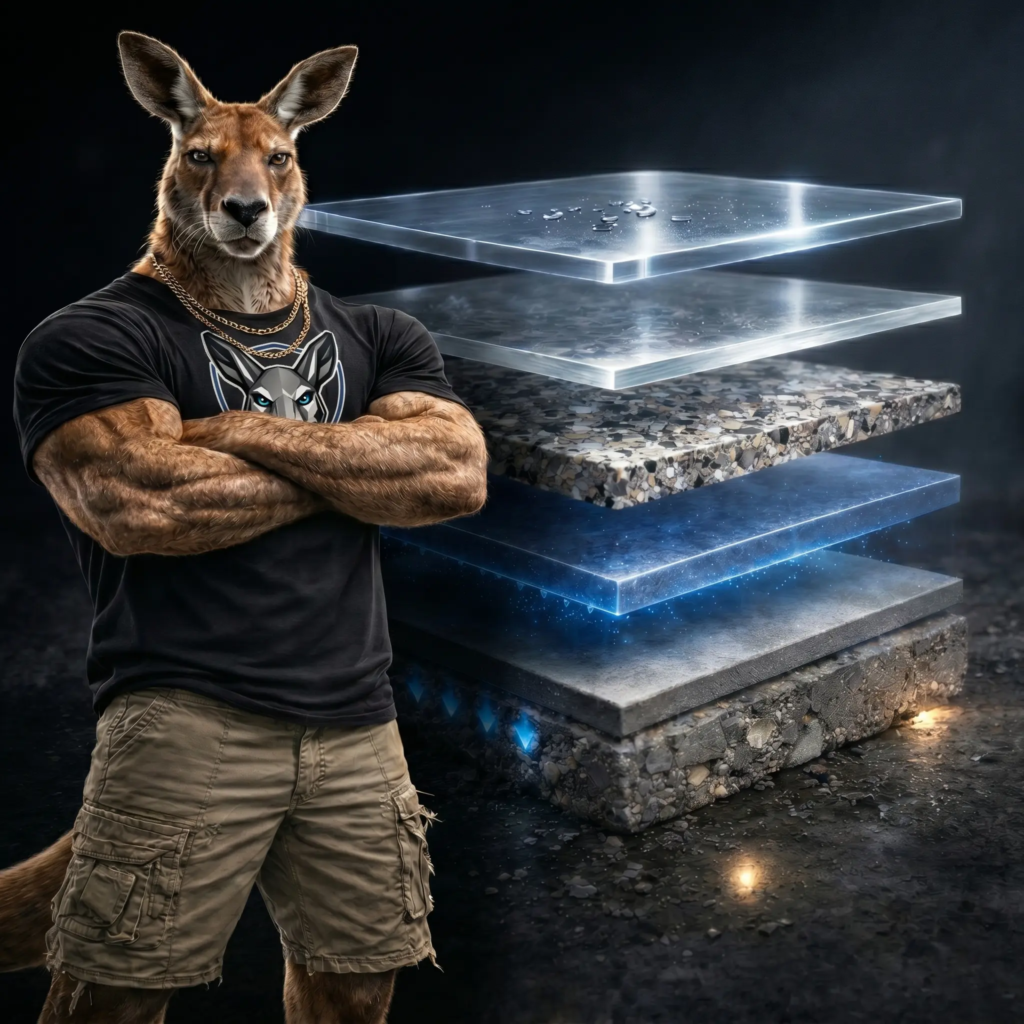
A structured five-layer system designed to prepare, protect, and perform.
Each layer serves a defined purpose. Together, they create a surface built to hold up under real-world conditions.
Blog Rubaroc Vs. Polyaspartic: Which is right for your Pool Deck? Thinking about Rubaroc rubber surfacing for your pool deck or patio? See how it
Real Jobs, Real Surfaces, Real Results: Our Featured Projects So Far We’re kicking off a new Featured Projects series to show the community exactly what
Outback Concrete Coatings Now Serves Indianapolis been coating garage floors, basements, patios, driveways, and commercial floors across northeast Indiana and the surrounding region for years
The Last Few Weeks Before School Starts. Use Them. There’s a specific kind of pressure that hits every August. The calendar fills up fast —
The State of the Concrete Coating Business in Indiana: Why 2026 Is a Breakout Year If you’ve noticed more garage floors with that sharp, high-gloss
Get insights into the concrete installation process with Outback Concrete Coatings in Fort Wayne, Indiana, ensuring quality results.