
A driveway carries more load, more cycles, and more weather exposure than almost any other concrete surface on your property. Indiana winters are particularly brutal — freeze-thaw cycles, road salt, and the weight of vehicles sitting on a slab that was poured just thick enough to pass inspection. Here's why most driveways don't hold up.
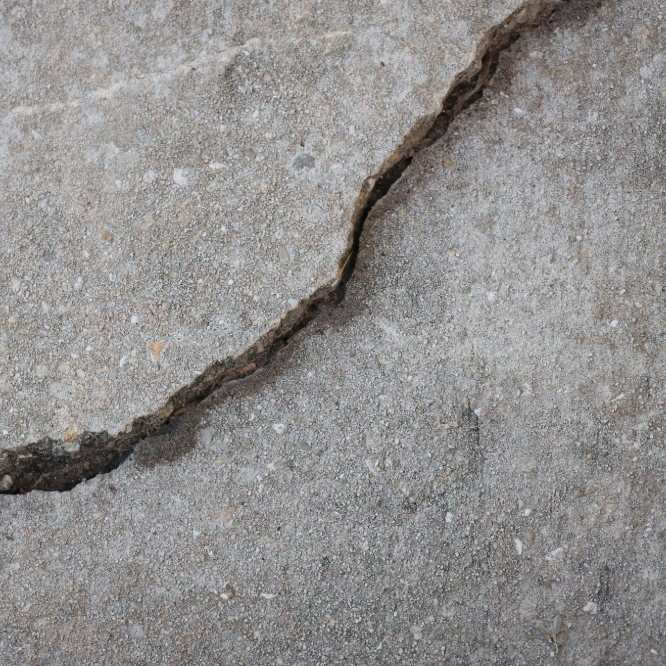
The standard residential driveway is poured at 4 inches — the industry minimum. A 4" slab without rebar doesn't have the structural capacity to handle decades of vehicle loads and freeze-thaw cycling. It's not a question of if it will crack. It's when.
Most residential driveways are poured unreinforced or with wire mesh that ends up at the bottom of the pour doing nothing. Without properly elevated rebar in the structural center of the slab, there's no tensile strength holding the concrete together when it wants to crack.
A driveway is only as stable as the base beneath it. Uncompacted subgrade, insufficient aggregate depth, and poor drainage setup cause slabs to settle unevenly — creating the heaved sections and low spots that collect water and accelerate freeze-thaw cracking.
Salt tracked in from Indiana roads penetrates concrete pores, causes surface scaling and spalling, and accelerates steel corrosion in any rebar present. A properly sealed or coated driveway surface significantly reduces the rate of salt damage over time.
"If your driveway can still be coated rather than replaced, we'll tell you that. We do coatings too — there's no incentive to push you to replacement if a coating holds."
Standard driveway replacement pours at 5 inches. ArmorSlab™ driveway replacement pours at a minimum 6 inches — 20% thicker, with 44% more bending capacity and 73% more stiffness. Every step of the build is documented before concrete is placed.
Full mechanical removal and haul-off of the existing slab. No overlays, no resurfacing over a failed base. Complete removal so every decision about what goes back down is made correctly from the start.
We assess the subgrade for soft spots, voids, and drainage issues — then build and mechanically compact an aggregate base at the correct depth. The base is what prevents a new driveway from settling unevenly under years of vehicle load.
#4 steel rebar laid in a proper grid on approved plastic chairs — elevated to sit in the structural center of the slab. This is the tensile reinforcement that resists cracking from vehicle loads and ground movement. Rebar on the ground is nearly useless. Properly elevated rebar is what holds a driveway together for decades.
High-strength, air-entrained exterior concrete with fiber reinforcement mixed in throughout. Works alongside the rebar to reduce micro-cracking during curing and improve the slab's surface impact resistance — particularly important on a surface that takes vehicle loads and road salt year-round.
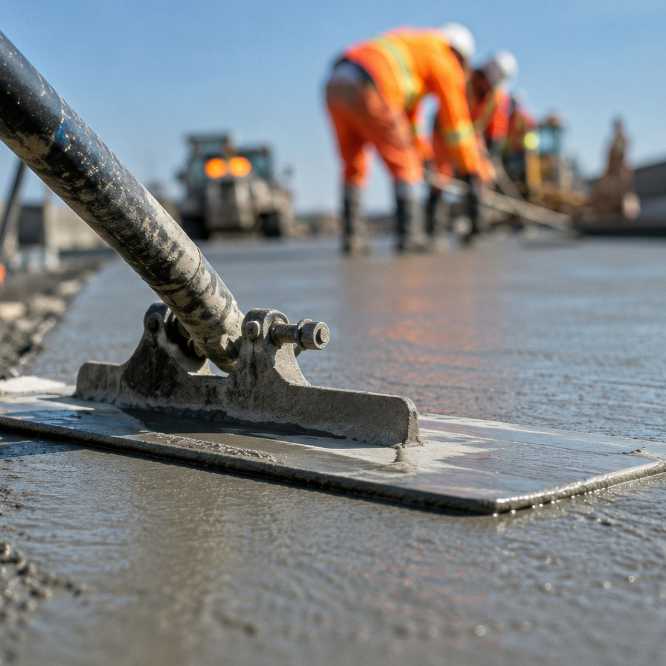
Poured at 6" minimum — 20% thicker than the standard 5" driveway. Set at the correct slope to drain water away from your home and garage. Control joints cut at proper spacing. Broom finish for traction; smooth or exposed aggregate finish available on request.
Before any concrete is poured we photograph the compacted base, rebar layout and chair elevation, form setup, depth verification, and drainage slope. You receive the full pre-pour inspection record — the documented foundation of the 10-Year Structural Warranty on qualifying driveways.