

Concrete Replacement

Concrete Flatwork

Pads, slabs, aprons, steps, equipment bases, and any other concrete flatwork your property needs — Outback pours it to ArmorSlab™ standards. Thicker than the industry minimum, reinforced with steel rebar and fiber, documented before the pour, and backed by a 10-Year Structural Warranty on qualifying installations.

Request Service

OR CAll Us Directly

Request Service

OR CAll Us Directly

LIFETIME WARRANTY

Armor Core System™

A+ BBB RATED

1 DAY INSTALL

NO PEEL PROMISE

MOISTURE MITIGATION

LOCATED IN FORT WAYNE

What We Pour

If It's Flat Concrete,
Outback Pours It.

Flatwork is any concrete surface that sits horizontal — poured, formed, finished, and left to carry load, weather, and time. Most flatwork failures trace to the same root causes: poured too thin, no rebar, poor base prep. Every Outback pour fixes all three before the truck arrives.

Residential Flatwork
✓Garage aprons & approach slabs
✓Patio slabs & outdoor living areas
✓Driveway extensions & widening
✓Sidewalks & walkways
✓Steps & stoops
✓Pool deck surrounds
✓Generator & HVAC equipment pads
✓Shed & outbuilding pads
Commercial & Light Industrial
✓Parking areas & loading zones
✓Equipment pads & machinery bases
✓Dumpster pads & service areas
✓Dock aprons & approach slabs
✓Exterior walkways & access paths
✓Interior slab repairs & section replacement

"Not sure exactly what category your project falls into? That's fine — describe it at the free estimate and we'll scope it, spec it, and price it correctly."

The Standard

Every Outback Pour
Follows the Same
ArmorSlab™ Standard.

Most concrete contractors pour to minimum code — because that's what gets bid and what most clients ask for. Minimum code is how you get flatwork that starts cracking in five years. ArmorSlab™ flatwork is built above minimum at every step.

1
Site Assessment & Scope

We walk the site, assess soil conditions, drainage slope requirements, load demands, and any existing concrete to be removed. The scope and spec come from what the project actually needs — not what's easiest to quote.

2
Demo & Removal (If Needed)

Failed or replacement flatwork is mechanically removed and hauled off. On new pour projects — equipment pads, additions — we work with the existing grade and drainage to set up the pour correctly.

3
Subgrade Prep & Compacted Base

Mechanically compacted aggregate base at the proper depth for the slab type. Stable base, correct drainage slope. This is the step most contractors minimize because it's invisible once concrete is poured — and the most important step for long-term performance.

4
BridgeBuilt™ Rebar Reinforcement

#4 steel rebar on approved plastic chairs, correctly elevated so it sits in the structural center of the pour. Rebar on the ground adds almost no value. Properly positioned rebar is the difference between a reinforced slab and a slab that just has rebar in it.

5
Fiber-Reinforced Concrete Mix

High-strength, air-entrained exterior concrete with fiber reinforcement throughout the mix. The fibers reduce micro-cracking during curing and improve the slab's surface impact resistance — a meaningful upgrade that most flatwork contractors don't include.

6
Pour, Finish & Control Joints

Poured at the correct thickness for the application, finished to the specified texture, and cut with control joints at proper spacing to direct unavoidable concrete movement to planned locations. Broom finish standard; exposed aggregate, brushed, or troweled smooth on request.

7
Pre-Pour Documentation

Before any concrete is poured, we photograph the compacted base, rebar layout and chair elevation, depth verification, form setup, and drainage slope. The record confirms the work was done correctly and is the documented foundation of the 10-Year Structural Warranty on qualifying pours.
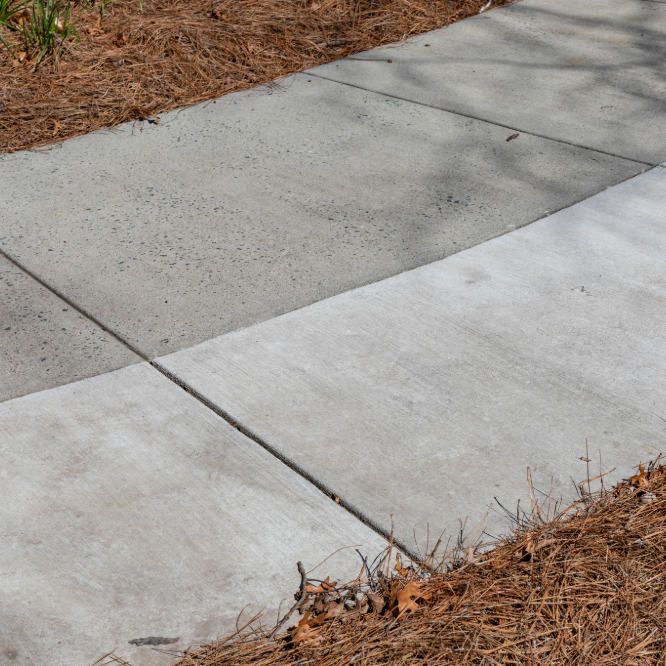
Concrete flatwork installation Fort Wayne Indianapolis — ArmorSlab pour
The Warranty

10-Year Structural Warranty.
Written. Before We Pour.

Most flatwork contractors offer nothing after the job is complete. Qualifying ArmorSlab™ flatwork installations are backed by a 10-Year Structural Warranty covering structural failure from defective installation or workmanship.

✓ Structural failure from defective installation or workmanship
✓ Pre-pour documentation confirms the build standard before concrete is placed
✓ 10-year coverage on qualifying ArmorSlab™ flatwork pours
Not a No-Crack Guarantee

All concrete cracks. Control joints are cut specifically to direct that movement to planned locations — cracks at control joints are expected and normal behavior, not a warranty issue. The 10-Year Structural Warranty covers qualifying structural failure caused by defective workmanship. We walk through this at every estimate so there are no surprises.

Want to Coat It Too?

Once your new flatwork has fully cured — typically 28 days for full concrete strength — it can be coated with the ArmorCore™ system to add color, protection, and a finished surface. Garage aprons, patio slabs, walkways, and equipment pads all coat well. Many clients plan both from the start — ask about it at your free estimate.

See the ArmorCore™ Coating System →
FAQ

Common Questions About
Concrete Flatwork.

What exactly is concrete flatwork?+
Flatwork is the industry term for any horizontal concrete pour — surfaces that lie flat and carry load, foot traffic, or vehicle weight. Driveways, patios, sidewalks, garage aprons, equipment pads, pool deck surrounds, and shed bases are all flatwork. Essentially, if it's poured concrete that lies flat, it's flatwork.
How thick does my flatwork need to be?+
It depends on what the slab needs to carry. Sidewalks and walkways are typically 5 inches minimum under ArmorSlab™ standards — versus the 4-inch industry minimum. Driveways pour at 6 inches minimum. Equipment pads and heavily loaded slabs may spec thicker depending on the load. We determine the correct thickness at the free estimate based on the application.
Why does flatwork crack and what can prevent it?+
Flatwork cracks for three primary reasons: poured too thin, no rebar reinforcement, and inadequate base preparation. Indiana's 100+ freeze-thaw cycles per winter accelerate all three failure modes — water gets into pores, freezes, expands, and opens cracks wider every year. You can't prevent all cracking — that's why we cut control joints — but you can prevent structural cracking through proper thickness, rebar, fiber reinforcement, and base prep. That's the ArmorSlab™ standard.
Do you do small flatwork projects or only large pours?+
We work across a wide range of project sizes — from a single equipment pad or shed base to multi-section driveway and patio pours. Project minimums apply, and we'll discuss scope honestly at the estimate. If your project is too small for us to take on cost-effectively, we'll tell you that plainly rather than waste your time.
What is fiber reinforcement and why does it matter?+
Fiber reinforcement is added to the concrete mix before the pour — thousands of short synthetic fibers distributed throughout the entire slab. It works alongside the rebar (not instead of it) to reduce micro-cracking during curing and improve the slab's resistance to surface impact over time. It's an upgrade that most flatwork contractors don't include because it adds cost but isn't visible after the pour. It's standard on every ArmorSlab™ pour.
Does the warranty mean my flatwork won't crack?+
No — and any contractor who promises crack-free concrete is not being honest. All concrete moves with temperature changes, and that movement produces cracks. Control joints are cut into the slab specifically to direct that inevitable cracking to planned, inconspicuous locations. The 10-Year Structural Warranty covers qualifying structural failure from defective installation or workmanship — not normal concrete behavior at control joints. We explain this clearly at the estimate so expectations are set correctly before any work begins.
How long before I can use new flatwork?+
Foot traffic is generally safe after 24–48 hours. Vehicle traffic on driveways and aprons typically needs 5–7 days. Heavy equipment or loaded vehicles need at least 28 days — full concrete strength is reached at 28 days, not at pour. If you plan to coat the new flatwork with ArmorCore™, 28-day curing is also required before coating can be applied. We'll give you specific timelines at the estimate based on your pour type and planned use.
Can I coat my new flatwork after it cures?+
Yes — and it's a popular combination. After 28 days of curing, new ArmorSlab™ flatwork can be coated with ArmorCore™ to add color, protection, and a finished surface. The new concrete is a clean, well-prepared substrate — ideal for a coating. Garage aprons, patio slabs, and walkways especially benefit from coating after replacement. Ask about it at your estimate and we'll price both together.
Get Started

Tell Us What
You Need Poured.

Free estimate. We assess the site, scope the project, and give you an exact price before any work begins. No pressure. No obligation. Just a straight answer on what it costs and what you get.

(260) 600-7600
✓BridgeBuilt™ Rebar + Fiber Reinforcement Standard
✓Pre-Pour Documentation on Every Job
✓10-Year Structural Warranty — In Writing
✓Fort Wayne & Indianapolis · A+ BBB