
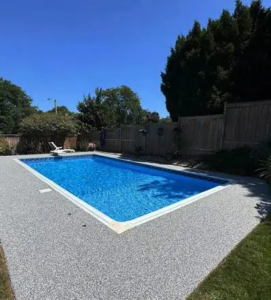
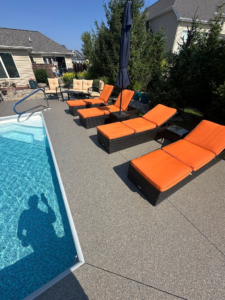
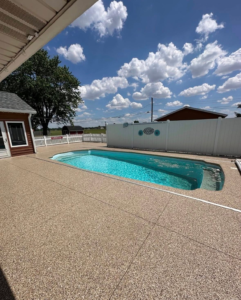
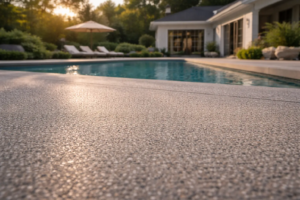
Rubaroc is a poured-in-place rubber safety surface. Small rubber granules are mixed on site with a resin binder, then poured and troweled directly over the existing substrate, concrete, asphalt, wood, brick, and several other surfaces, at about a quarter-inch thick. It’s designed to cure within about 24 hours and is permeable, so water drains through it rather than pooling on top.
It was originally developed for playgrounds and splash pads, where cushioning and fall protection matter most, and that DNA still shows in how it performs: soft underfoot, cool in the sun, and forgiving on bare feet.
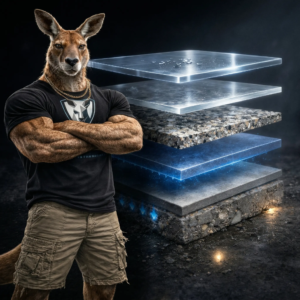
Polyaspartic is a fast-curing, aliphatic coating chemistry; a step up from standard epoxy in both toughness and UV stability. Our Armor Core System™ builds it into a five-layer process: diamond-ground surface prep, a moisture mitigation layer, a polyurea base with decorative color chips, a polyaspartic protective topcoat, and a slip-resistant finish coat. It’s installed in a single day, cures fast enough for foot traffic the next day, and is backed by a lifetime, no-peel warranty.
Unlike Rubaroc, it creates a hard, seamless surface rather than a cushioned one, closer in feel to a premium garage or patio floor than a rubber mat.
This is where the two products differ the most. Rubaroc’s rubber granules give it real give underfoot, which is a genuine advantage around pools where kids are running on bare feet or where fall protection is a priority, like a play area. It also tends to stay cooler in direct sun than a hard-troweled surface, which matters a lot in July.
Polyaspartic coatings are hard and dense. You won’t get the cushioning, but you do get a smoother, more finished look that reads more like a polished patio floor than a playground surface, closer to what most homeowners picture for an outdoor living space or entertaining area.
Both products are built to hold up outdoors, but they age differently. Rubaroc’s rubber-and-resin surface is flexible, which helps it resist cracking as the substrate below it shifts slightly with temperature changes. Over time, though, granulated rubber surfaces can be more prone to fading, surface wear in high-traffic paths, and occasional patch repairs where the resin binder breaks down.
Our Armor Core System™ is built around chemical and abrasion resistance; it holds up to pool chemicals, oils, and heavy furniture traffic without peeling or yellowing, and it’s the reason we’re comfortable backing it with a lifetime warranty rather than the one-to-three-year warranties typical of basic coatings. For homeowners who want a “set it and forget it” surface, that’s a meaningful difference.
Both systems install relatively quickly compared to full concrete replacement or tile. Rubaroc typically cures enough for light use within about 24 hours. Our one-day Armor Core System™ install also allows foot traffic the next day, and because it’s engineered for Indiana’s freeze-thaw cycles and clay-heavy soil, it’s installed with moisture mitigation built in from the start; something that matters more here than in the milder climates where a lot of rubber surfacing systems were originally designed to perform.
There’s no universal right answer. It depends on what the space needs to do.
Rubber surfacing like Rubaroc makes the most sense for pure play spaces: splash pads, playgrounds, and areas where cushioning and fall protection are the top priority over finished appearance.
A polyaspartic coating tends to be the better fit for pool decks, patios, and outdoor living areas that double as entertaining space; where homeowners want a durable, low-maintenance, good-looking surface that matches the rest of the home, backed by a warranty that holds up for the long run.
Side by Side
Two ways to resurface a pool deck. No spin.
| Category | Rubaroc | The Armor Core System™ Recommended |
|---|---|---|
| Surface Type | Cushioned rubber Poured rubber granules over substrate | ✦Hard, seamless coating Polyaspartic topcoat over polyurea base |
| Comfort Underfoot | Excellent | Good |
| Fall & Impact Protection | Excellent | Not Designed For |
| Abrasion & Wear Resistance | Good | ✦Excellent |
| Chemical & UV Resistance | Good | ✦Excellent |
| Water Drainage | Excellent Permeable by design | Good Sealed surface, sloped for runoff |
| Cure / Install Time | ~24 Hrs | 1-Day Install |
| Built for Fort Wayne Climate | Good | ✦Built For It |
| Warranty | Varies by Installer | Lifetime, No-Peel Promise |
We’d rather tell you which surface actually fits your project than push the one we happen to install. If you’re weighing rubber surfacing against a polyaspartic coating for a pool deck, patio, or outdoor space in Fort Wayne or Northeast Indiana, reach out for a free, no-pressure consultation. We’ll walk your space, talk through how it’s actually used, and give you a straight answer, even if that means pointing you toward a different solution.
Epoxy, polyurea, polyaspartic. They are not interchangeable. Choose wrong and you redo your floor in a few years. Choose right and it lasts.